 From professionals for professionals
 Satisfied customers

Acrylgel in a bottle: Advantages, Application, and Differences to BIAB & Gel
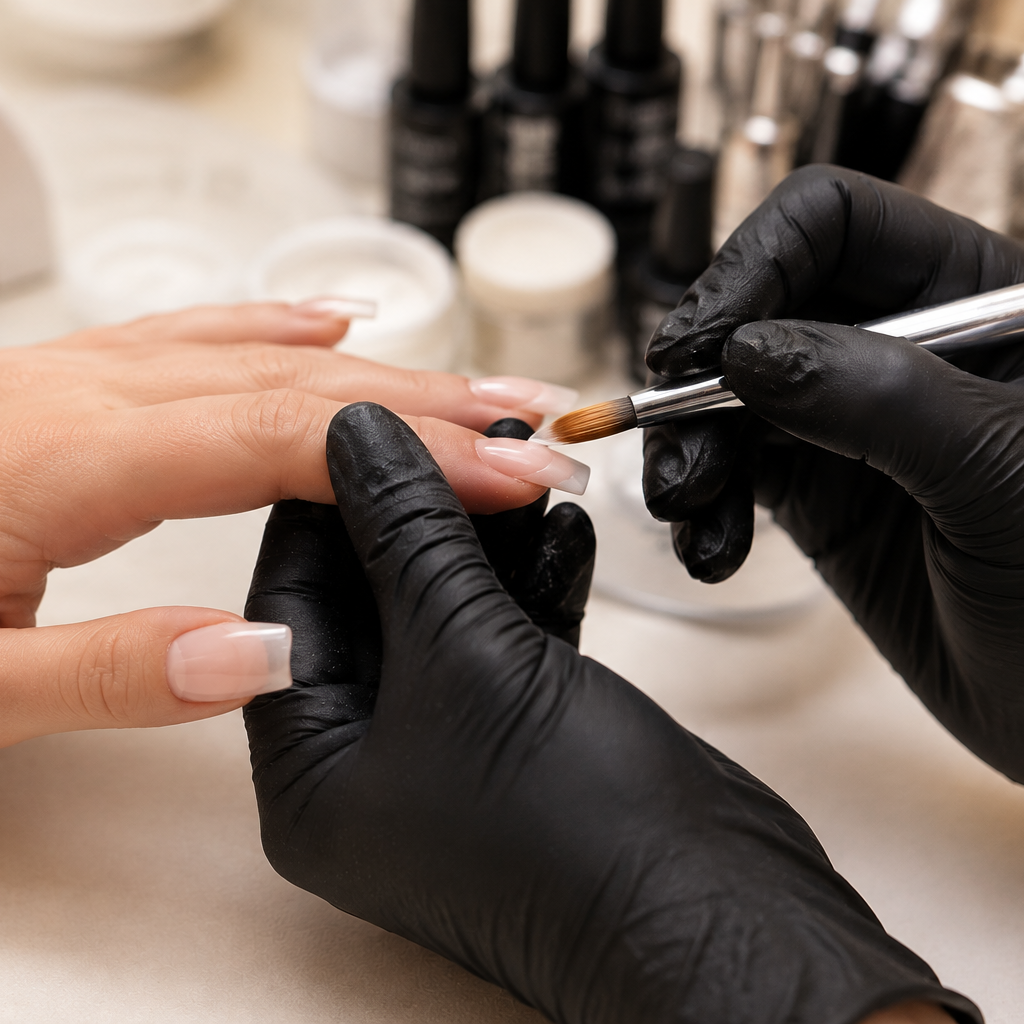
Anyone looking for a stable yet easy-to-apply nail modeling system will sooner or later come across Acrylgel in a bottle. This modern modeling material combines the advantages of classic builder gels with particularly convenient application directly from the bottle. Thanks to the integrated brush, application is clean, precise, and time-saving – both in professional nail salons and for home use.

But how does acrylgel differ from Builder in a Bottle (BIAB), Rubber Base, or conventional builder gel? This guide explains the key differences, advantages, and application possibilities.
What is Acrylgel in a bottle?
Acrylgel in a bottle is a stable UV/LED builder gel that combines the stability of classic acrylic systems with the easy application of a gel. Thanks to the practical bottle with an integrated brush, the material can be applied particularly evenly and is ideal for natural nail enhancements, short extensions, and refill applications. Modern acrylgels are often HEMA-free and offer high adhesion with easy processing.
What makes Acrylgel so special?
Acrylgel combines the positive properties of two proven modeling systems. It has the stability of an acrylic system and at the same time the pleasant workability of a UV gel. Unlike classic builder gels, the material flows much slower. This leaves enough time to cleanly model the nail structure and precisely place the apex.
Since acrylgel only cures under UV or UV/LED light, you can work without time pressure. Beginners in particular benefit from this controlled application.

The advantages of Acrylgel in a bottle
Acrylgel offers numerous advantages over classic modeling systems:
- easy application directly from the bottle
- integrated brush saves time
- stable consistency for precise work
- ideal for apex building
- hardly runs into the nail edges
- high stability with a natural feel
- suitable for natural nail enhancements and refills
- curing under UV or UV/LED light
- often available in HEMA-free formulas
Acrylgel or BIAB – what's the difference?
The terms Acrylgel in a bottle and Builder in a Bottle (BIAB) are often used interchangeably. In fact, both systems pursue a similar goal: stable natural nail reinforcement with easy application.
The main difference lies in consistency and stability. While many BIAB products are slightly more flexible and excellently suited for natural nails, acrylgel usually has a higher stability. This makes it easier to model the nail structure and achieve higher stability even with longer nails.
Both systems are perfectly suitable for short natural nails. Those who desire more stability or a more pronounced structure often opt for acrylgel.

Difference between Acrylgel and classic Builder Gel
Classic builder gels are often thin to medium viscosity and self-leveling. While this simplifies application, it requires a bit more experience, as the material can run into the nail edges more quickly.
Acrylgel, on the other hand, remains significantly more stable and allows for more controlled work.
| Acrylgel | Classic Builder Gel |
|---|---|
| stable | self-leveling |
| hardly runs | can run |
| easier apex | more experience required |
| high stability | varies depending on gel |
Acrylgel or Rubber Base?
Rubber Base primarily serves to strengthen natural nails and improves adhesion on flexible nails. However, it has significantly less stability than acrylgel.
If you only want a slight reinforcement of natural nails, a Rubber Base is a good choice. For a pronounced structure or longer extensions, acrylgel is significantly better suited.
Who is Acrylgel suitable for?
Acrylgel is suitable for both beginners and experienced nail technicians.
The material is particularly recommended for:
- soft or thin natural nails
- brittle nails
- natural nail enhancements
- refill applications
- short nail extensions
- clients with higher daily stress
Step-by-step instructions
- Clean and disinfect hands.
- Carefully push back cuticles.
- Buff natural nail.
- Thoroughly remove dust.
- Apply dehydrator and, if necessary, primer.
- Apply a thin layer of acrylgel.
- Model the apex.
- Cure completely under UV/LED light.
- If necessary, lightly file the structure.
- Finish with a top coat.
Common mistakes
Most liftings are not caused by the material itself, but by application errors.
Typical causes include:
- insufficient nail preparation
- material running into the nail edges
- missing apex
- too thick material layers
- incomplete curing
- incorrect lamp power
- oily or moist natural nails
Conclusion
Acrylgel in a bottle combines the easy application of modern UV gels with the stability of classic modeling systems. Thanks to its stable consistency, the material can be applied in a particularly controlled manner and is suitable for both natural nail enhancements and stable modeling. Anyone who values comfortable application, high durability, and professional results will find acrylgel a versatile solution for the salon and at home.